

Haunting the Hives
To the Lighthouse by Virginia Woolf

Only like a bee, drawn by some sweetness or sharpness in the air intangible to touch or taste, one haunted the dome-shaped hive, ranged the wastes of the air over the countries of the world alone, and then haunted the hives with their murmurs and their stirrings; the hives, which were people.
To the Lighthouse by Virginia Woolf

From Woolf’s novel, I could pluck a stunning sentence from any page, every page. When I first read To the Lighthouse, I stumbled around in a daze, as if someone had blown open the cloud layer and shown me how sentences could sing and whirl in directions I didn’t know existed. All that the poets know, Woolf knows, all the rhythm and sound, and it’s in her prose. Can you hear it?
With this sentence, Woolf creates exquisite tension by delaying what the bee and hive are being compared to. Why do this? What Woolf is doing is mimicking the privacy of a mind that thinks of the image first and, at the last second, concedes to include the reader.
The sentence opens with a short phrase that introduces a simile: “Only like a bee.” But we get only one prong of the simile. If a simile is “A is like B,” in this sentence, we have B but not A. I’m going to call A the “target,” or what is being discussed, and B the “source,” or the concept/image to which the target is being compared.
We have to wait to discover the “target,” A, because what follows is more details about the bee: “drawn by some sweetness or sharpness in the air.” Woolf uses balance, or the pairing of two things with “sweetness or sharpness,” to create a pattern of sound and an eloquent rhythm: SWEETness or SHARPness (heavier stresses capitalized). The alliteration of the “s” renders more music and draws the ear to the sibilants. She creates variety by mixing sensory categories with taste and touch.
The next modification concerns what’s in the air, and by adding this second layer, Woolf holds the reader right there, in this moment, feeling the air: “intangible to touch or taste.” Again, she uses balance, and this time she alliterates “t,” a plosive, providing variation of sound.
Now we come to the base clause: “one haunted the dome-shaped hive.” The initial simile, “like a bee,” is finally connected to the target, “one,” an abstract, universal pronoun that invites the reader into the moment. And a new metaphor is introduced, “the dome-shaped hive,” along with another delay in what the hive is being compared to. The base clause continues to grow through two more verbs: “ranged/haunted.”
The first verb phrase is “ranged the wastes of the air over the countries of the world alone.” The phrase “wastes of the air” plays with the usual wording, “wasteland,” and invites the reader to see the sky as a vast landscape.
In the second verb phrase, Woolf repeats the verb “haunted”: “and then haunted the hives with their murmurs and their stirrings.” In this part of the novel, Lily Briscoe is wondering how one knows anything about another person. Now we have a better understanding of the word “haunted,” which, in this context, is not about a ghost but about frequently interacting or spending time with people. By returning to the word “haunted,” Woolf creates a circular motion—you’re drawn to people, then head out into the world alone, then return to people. Again, Woolf uses balance with “their murmurs and their stirrings,” rendering a pattern of stresses MURmurs and STIRrings. And there’s the music of the repeated “their.”
After the semicolon, we learn hives are compared to people: “the hives, which were people.” Reading the sentence again, I hear so much assonance with bee/sweetness/people; taste/shaped/ranged/wastes; dome/alone; murmurs/stirrings.
At our recent Zoom gathering behind the paywall, we talked about psychic distance and how that affects everything. Psychic distance is the distance between the reader and the events of the story. Throughout the novel, Woolf narrows the distance between the reader and her characters’ minds, and in this instance, we’re deep in Lily Briscoe’s thoughts.
Your Turn
Open with a short phrase that includes one part of a simile, the “source.”
Add a modifier to give us more details about that image. Can you use balance, the pairing of two things? Now add more details about the image and more balance.
Now comes your base clause, which reveals the “target,” or what the opening simile refers to. Here, introduce a new simile, but include only the “source.”
Use two more verbs to lengthen the base clause. For your third verb, repeat the initial verb. Can you add balance?
Add a semicolon, then reveal what the second simile referred to.
Try it!
How did it go?
If you like, share your sentence in the comments below. Our lovely, lively writing community has grown! I’m so happy about this, but as you might suspect, commenting on everyone’s sentences has become overwhelming. For paid subscribers, I’ll be commenting to thank you for supporting my work. Please consider a paid subscription for $6 a month. Thank you!
Paid Subscribers Receive:
Comments on weekly posts.
Swimming in Style: A monthly Zoom gathering in which we analyze and write a stunning paragraph, filled with style techniques. Our next gathering is Sunday, June 21, at 11:00 am Pacific Time. If you can’t make it, I’ll send a recording.
Sentence Intensive: A stunningly glorious sentence from a published work sent to you for five consecutive days with analysis and instructions on how to make it. We have four of these each year.
Access to 300 stunning sentences analyzed with instructions on how to make them.
Q&A: Access to questions from subscribers and my answers, with wonderful insights from the writing community.
Here are the instructions on how to become a paying subscriber:
New Class: The Art of Compression!
I’m teaching a class for Flash Fiction magazine on compression. Some of you attended the “Ask, Write, Repeat,” which was sort of like taking a car out for a test run. Compression isn’t subtraction; it’s intensification. You’ll learn that dialogue can do more than one thing, including carry the weight of the past or the present conflict. Verb tense smuggles in years of backstory, where what’s left out is doing more work than what’s left in.
So far, I have ten compression techniques, drawn from published works. Whether you’re writing flash fiction (1,000 words or less), a short story, a novel, or a memoir, compression helps you make your writing sharper and shinier. We’ll talk about imagery, dialogue, sequencing, telling, summary (both kinds), and more. And you’ll write a story. It’s June 6 and 7th from 10:30-1:30 Pacific Time. If you can’t make it, there’s a recording (lifetime access!) Here’s the registration link:
Short Story Ties for First Place!
My short story, “The Velvet Chair,” tied for first place in Blue Mesa Review’s short story contest. As the judge said, “I hope we all find our velvet chair.”
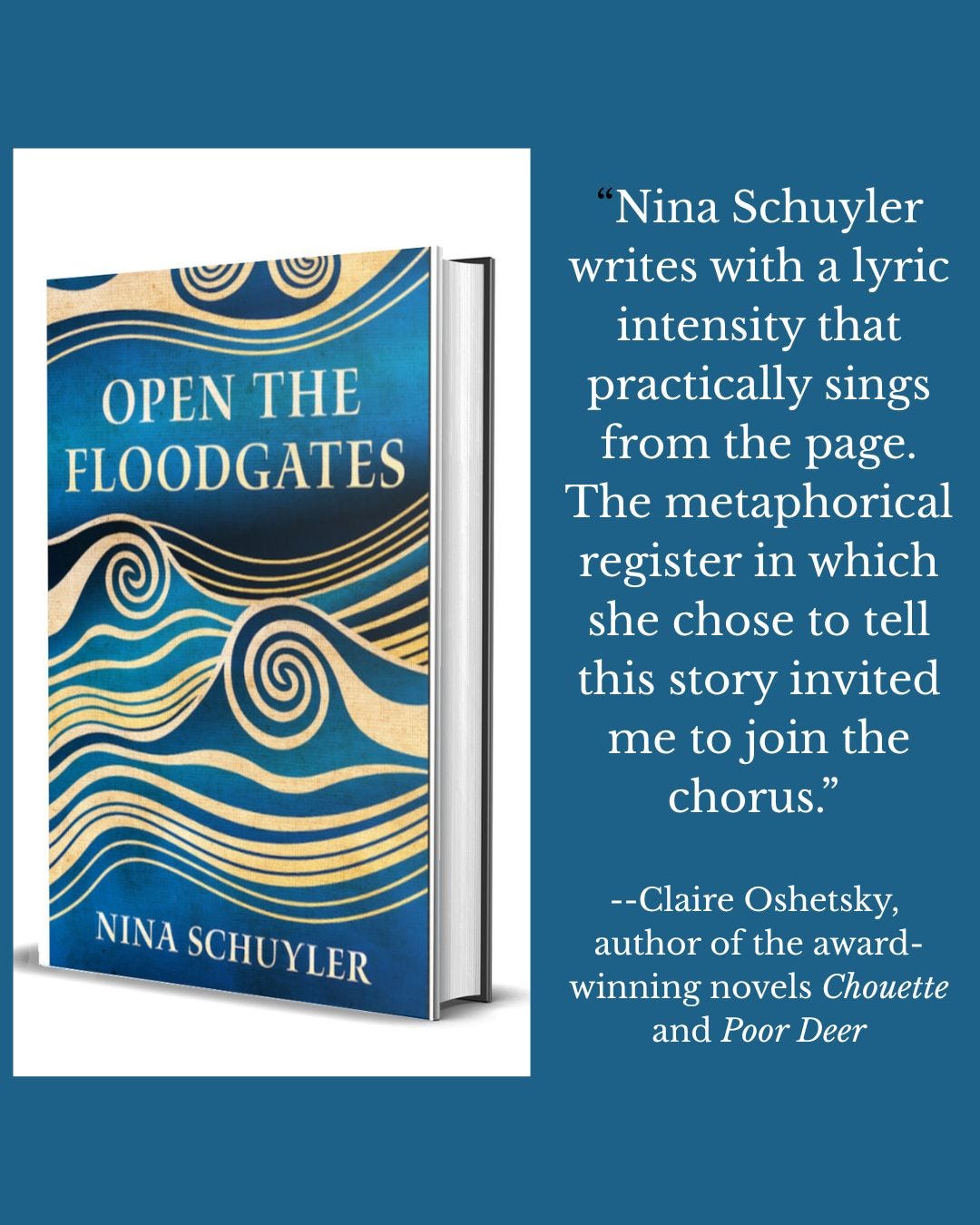
Thank you, Claire Oshetsky, for your generous words! This means so much to me. Claire has such a rich, deep imagination; you must read her novels. Lucky us, she has a new one out, Evil Genius. Thank you for helping this novel find its way! Open the Floodgates is available for pre-order.
Consider a One-Time Donation
—a $5 tip, like applause, a cheer, a little gift for a job that brought you a bit of inspiration: Ko-fi.com/stunningsentences
Like a lion, slinking away from the crash and slash of battle in an unstated surrender of power and purpose, retreating from the savannah like playground, enduring the roars of a pride rallying around a new king, retreating under the thunder of grumbles and growls, was my baby sister's former bully.
Only like a fox, drawn by some presence or absence in the night impossible to hold or name, one haunted the voice you could still almost hear, ranged the distances of memory over the moments of a single life alone, and then haunted the memories with their warmth and their absence; the memories, which were her.