

Men Being Buried
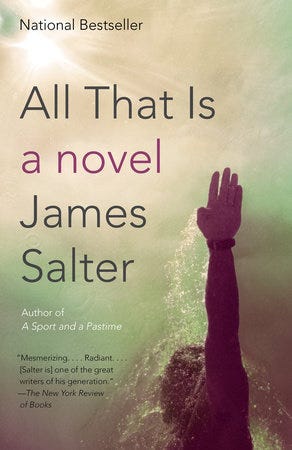
All That Is by James Salter

In tier on tier of iron bunks below deck, silent, six deep, lay hundreds of men, many face up, with their eyes still open though it was near morning.
All That Is by James Salter

Reading one novel by James Salter led to the next, and the next, and I’ve been swept up in his distilled, eloquent prose. As Peter Matthiessen said in a review, “There is scarcely a writer alive who could not learn from [Salter’s] passion and precision of language.”
This sentence comes from the opening of All That Is. Fifteen hundred soldiers are packed on the ship, heading to Okinawa. It’s near the end of World War II, and they’re supposed to bomb Japan and end the war in the Pacific.
What I love about this sentence is that it beautifully simulates the soldiers’ anxious fever dream of being killed and buried. With phrase after phrase piled on before we get to the base clause, it’s as if the soldiers are buried by the syntax.
It’s a left-branching sentence, which means the modifiers come first, to the left of the base clause. This syntactical structure creates suspense as the reader waits for the subject and verb: “In tier on tier of iron bunks, below deck, silent, six deep.” The diction “below” and “deep” magnify the layering and buried feeling.
There’s a paradoxical movement. One word follows the next, moving horizontally from left to right, and yet the syntax creates verticality, with a strong sense of below and, implicitly, above.
Salter clusters plosives, those harsher sounds—t,b,d,k,p, g—with “tier, tier, bunks, deck, silent, deep.” They’re sharp, crisp consonants that are made by briefly stopping the flow of air and letting it go in a burst. A perfect sound for anxious men heading to battle.
Salter isn’t done burying the men. If he’d written the independent clause in a traditional way, it would have followed the canonical subject-verb predicate order and looked like this: “hundreds of men lay.”
Instead, the verb comes first, “lay hundreds of men,” which not only creates further delay but also generates more language to bury the men. The stylistic technique is called hyperbaton—the inversion of the usual word order. (If only one word is inverted, it’s called anastrophe.)
Now Salter zooms in on the men, pulling the narrative lens tight, using ellipses to describe how they’re sleeping: “many face up.” Without ellipses, it would be “many of them face up.” And then more description, “with their eyes still open,” presumably too anxious to sleep, which is reinforced by the subordinate clause, “though it was near morning.”
Your Turn
Open with three phrases that establish the setting and describe the subject.
Now comes your base clause (also called an independent clause). One way to create hyperbaton—the inversion of the usual order of words—is to write the sentence in the traditional way with a subject followed by the verb. Now flip it and put the verb first.
Add two phrases that further modify the subject.
Try it!
How did it go?
If you like, share your sentence in the comments below. Our lovely, lively writing community has grown! I’m so happy about this, but, as you might suspect, to comment on everyone’s sentences has become overwhelming. For paid subscribers, I’ll be commenting to thank you for supporting my work. Please consider a paid subscription for $6 a month. Thank you!
If you do so before Monday, May 11, you can join the Sentence Intensive! Five stunning sentences in five consecutive days to push language, to stretch beyond your ingrained range and wake up the grammar neurons, and to receive the immense support of a wonderful writing community. I’ll be providing comments.
Paid Subscribers Receive:
Comments on weekly posts.
Swimming in Style: A monthly Zoom gathering in which we analyze and write a stunning paragraph, filled with style techniques. Our next gathering is May 23 at 11:00 am Pacific Time. If you can’t make it, I’ll send a recording.
Sentence Intensive: A stunningly glorious sentence from a published work sent to you for five consecutive days with analysis and instructions on how to make it. We have four of these each year.
Access to 300 stunning sentences analyzed with instructions on how to make them.
Q&A: Access to questions posed by subscribers and answered by me, with wonderful insights from the writing community.
Here are the instructions on how to become a paying subscriber:
About Me
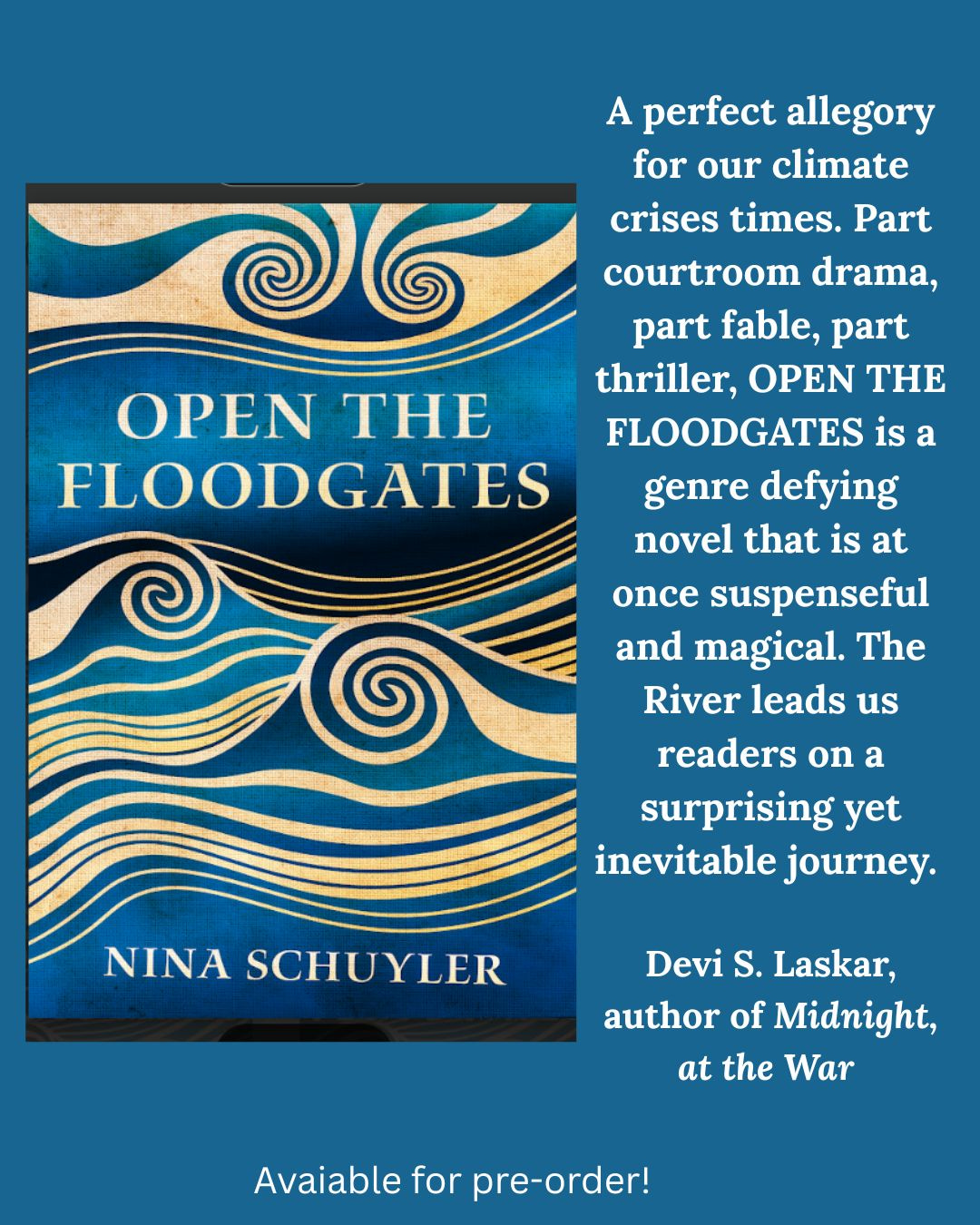
I’ve taught “Style in Fiction,” “Word for Word,” and “Cultivating Your Prose” for the University of San Francisco’s MFA program and Stanford Continuing Studies since 2007. My short story collection, In this Ravishing World, won the 2025 PEN Oakland Josephine Miles Literary Award. It was a finalist for the Northern California Book Award and won the W.S. Porter Prize and the Prism Prize for Climate Literature. My award-winning novel, Afterword, was published in May 2023. My novel, The Translator, was a finalist for the William Saroyan International Writing Prize, and The Painting was a finalist for the Northern California Book Award. My new novel, Open the Floodgates, will be published on September 15, 2026. www.ninaschuyler.com
Sentence Lovers! New second editions of my nonfiction books, How to Write Stunning Sentences and Stunning Sentences: A Creative Writing Journal, are available.
I’m excited to receive this advance praise from a writer I admire enormously! Pre-orders mean a lot to the press and bookstores, which base their stock decisions on those numbers. Thank you for helping this novel find its way!
Consider a One-Time Donation
—a $5 tip, like applause, a cheer, a little gift for a job that brought you a bit of inspiration: Ko-fi.com/stunningsentences
Rows upon rows of olive trees studded the rust-colored hills like cloves, diamond-shaped, but on I drove, patterns stamped in my tired brain, towards the Islamic jewel of Spain, the Alhambra.
Through hour after hour of sluggish traffic, shut tight windows, wildfire smoke, crept carloads of families, kids jammed between hastily packed bags, dozing though it was midday.