

Looking for the Next Circus
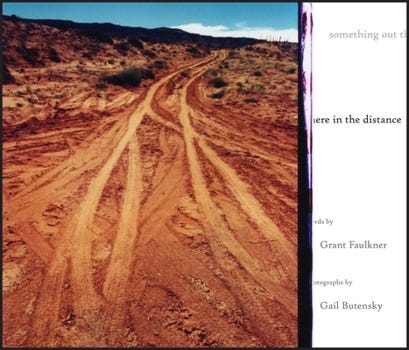
something out there in the distance, by Grant Faulkner and photographs by Gail Butensky


You’ve just got to keep moving, looking for the next circus, dancing the next dance—because you can’t die when you’re laughing, you can’t die when you’re spinning around. Or that was Dawn’s theory.
something out there in the distance, by Grant Faulkner and photographs by Gail Butensky
Grant Faulkner is the cofounder of Flash Fiction Institute, Memoir Nation Podcast, the Substack Imitations: A Writer’s Discourse, and author of The Art of Brevity. With his compressed writing style, he’s created a moving, original novelesque story about two lovers, Jonny and Dawn, on the run from death. Each story feels like a postcard, even more so because most are accompanied by stunning photos by Gail Butensky.
Faulkner’s long sentence renders a feeling of anxiety, as one participial phrase piles up after the other, as if the sentence itself is trying to run from death by continuing to add more.
Faulkner opens with a base clause: “You just got to keep moving.” There’s a colloquial tone from the low register language, “just got,” and the hint of a cliché. This makes sense because the sentence is paraphrasing Dawn and her theory.
What follows the base clause expands what “moving” means. And now we’re in a cumulative sentence, with the base clause elaborated upon by accumulating details. It’s a type of sentence that has a paradoxical movement—moving forward through specificity and backward because it refers to the base clause. It makes the reader stay still for a moment. (Over with the paid subscribers, we’ve been talking about how to create, as Ursula K. Le Guin said, a “hold still” moment and we added this technique to the list).
Two present participial phrases (verb+ -ing) add more specificity to the word “moving.”
1) looking for the next circus
2) dancing the next dance
With these phrases Faulkner uses balance, the pairing of two things, to create an eloquent rhythm. The image of a circus generates many associations—entertainment, fun, joy, distraction, stepping outside habitual action, defying limitations (I’m thinking of the trapeze artists and the contortionists)—so much that is not on the page.
In the second phrase, with “dancing… dance,” Faulkner uses epanalepsis, the repetition of word(s) at the beginning and end of a phrase or clause. Repetition always creates meaning. Always. The word draws attention to itself; it stands out. If the page is a field, the repeated word is a mountain. It also heightens emotion. Again, the word “dancing” and “dance” proliferate associations. With “dancing” and “dance,” he uses polyptoton, repetition of words derived from the same root but with different endings.
In both participial phrases, he repeats the word “next,” which reinforces Dawn’s theory that continuous motion is the way to defy death: there has to be a next thing.
The em dash breaks the sentence’s flow. It also creates a moment of suspense before the sentence turns in a new direction. Now comes a subordinate clause that provides an explanation: “because you can’t die when you’re laughing, you can’t die when you’re spinning around.” Nesting inside the subordinate clause are two balanced clauses that echo the rhythm of the participial phrases:
1) You can’t die when you’re laughing
2) You can’t die when you’re spinning around
The two clauses are connected by a comma—and yes, this is a comma splice, and your English teacher wouldn’t like it, but Faulkner wants to create speed and anxiety, simulating the content and trying to evade death by movement.
I hear the ring of the –ing sound throughout, with “laughing” and “spinning,” and “moving,” “looking,” and “dancing.” All of these words convey continuous activity, with the diction simulating the theory.
The second sentence is short; it’s abrupt, in stark contrast with the expansive first sentence: “Or that was Dawn’s theory.” It creates a new rhythm. “That” refers to the entire first sentence and performs, subtly, a rhetorical reversal. An interesting narrative distance has opened, inviting the reader to question Dawn’s theory for evading death.
Your Turn:
Open with a short base clause. Since we’re practicing, make it state a belief.
Add two present participial phrases (verb + ing) that modify something in the base clause. Can you repeat a word as Faulkner did with “next”? Can you use polyptoton? Epanalepsis?
Add an em dash
Add “because,” which now provides the explanation for the base clause. Use two clauses that are syntactically similar and connect them with a comma (comma splice).
Add a short second sentence.
Try it!
How did it go?
For paid subscribers, I’ll be commenting to thank you for supporting my work. Please consider a paid subscription for $6 a month. Thank you!
Paid Subscribers Receive:
Comments on weekly posts.
Swimming in Style: A monthly Zoom gathering where we analyze and write a stunning paragraph filled with style techniques. Our next gathering is Saturday, August 15, at 11:00 am Pacific Time. If you can’t make it, I’ll send a recording.
Sentence Intensive: A stunningly glorious sentence from a published work sent to you for five consecutive days with analysis and instructions on how to make it. Our next intensive is August 17-21.
Access to over 300 stunning sentences analyzed with instructions on how to make them.
Q&A: Access to subscriber questions and my answers, with wonderful insights from the writing community.
Here are the instructions on how to become a paying subscriber:
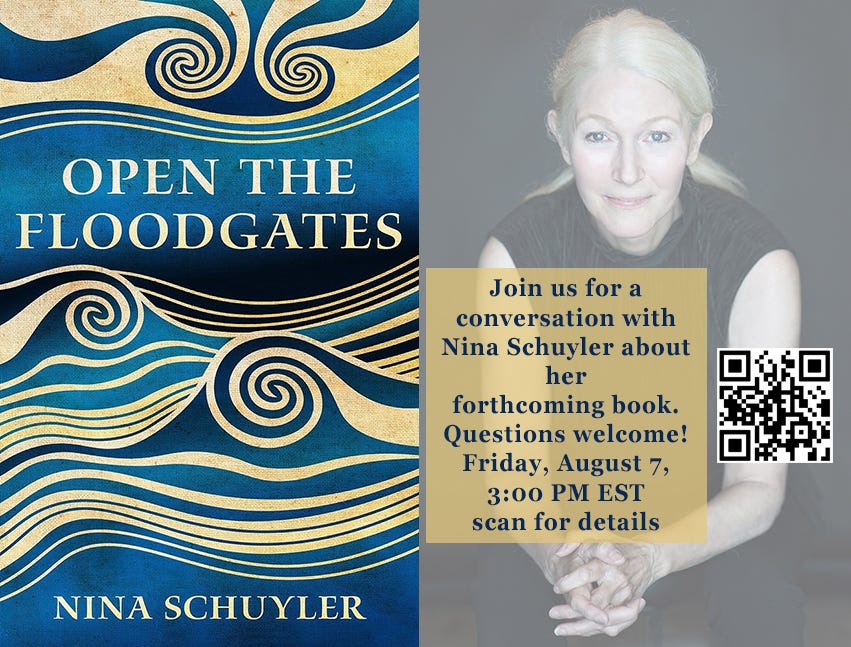
I’m thrilled to be in conversation on a Substack Live with Julie Gabrielli, who writes the Substack Homecoming, about my new novel, Open the Floodgates. August 7, 12:00 pm, Pacific Time. Please join us!
What’s this book about? The River is granted personhood and has the right—and urgent need—to argue in court for its existence. A blend of magic and pathos, courtroom drama and small-town vibe, Open the Floodgates is available for preorder.
Buy a Book: Get a Gift!
If you preorder my novel and send me the invoice, I’ll analyze one of your sentences and also offer suggestions. Available for the first 300 preorders! You can reach me at ninaschuyler@gmail.com
You need the courage to wait, watch, sit in the silence and listen - because you can never be sure what will come toward you, what you have invited. Then, suddenly, it’s here.
He knew it was time to ease, skinning the pear slowly, relishing the pleasure of anticipation–basking in the moments of sunlight, basking in the time before gloom. Enrico had made this his way.